A Mauritania work visa involves two separate approvals: an e-Visa for entry into the country (applied for online through the ANRPTS portal) and a work permit issued by the Ministry of Employment. You cannot legally work in Mauritania with only a tourist or business visa – you need employer sponsorship and a formal work authorization. This guide explains the full process, documents, fees, and timeline for working legally in Mauritania.
What Is a Mauritania Work Visa?
Mauritania does not have a single “work visa” stamp you get at an embassy. Instead, working legally in Mauritania requires two separate authorizations:
- An e-Visa for entry – applied for online through the ANRPTS portal at anrpts.gov.mr. This gets you into the country. For employment purposes, you would typically select “Other” as your purpose of travel on the application.
- A work permit (autorisation de travail) – issued by the Mauritanian Ministry of Employment after your employer submits a sponsorship application on your behalf. This allows you to work legally.
Since January 5, 2025, all visa-required travelers must apply for an e-Visa online before departure. Mauritanian embassies and consulates no longer issue visas as of June 2025, and the visa on arrival system has been discontinued.
The e-Visa alone does not authorize employment. Think of it as your entry ticket – you still need the work permit to actually take a job. For a full list of available visa categories, see our guide to Mauritania visa types.
Who Needs a Work Visa for Mauritania?
Almost every foreign national needs authorization to work in Mauritania. The requirement applies regardless of whether you are employed by a local company, a branch of a foreign firm, or an NGO operating in Mauritania.
Citizens of visa-exempt countries (Algeria, Burkina Faso, Chad, Cote d’Ivoire, Gambia, Libya, Mali, Niger, Senegal, and Tunisia) can enter Mauritania without an e-Visa for up to 90 days. However, visa-free entry does not grant work rights. Even citizens of these countries need a work permit if they intend to be employed in Mauritania.
Diplomatic and service passport holders from 14 countries (Brazil, China, Egypt, Guinea-Bissau, Iran, India, Morocco, Russia, Romania, Spain, Syria, Turkey, UAE, and Yemen) are exempt from visa requirements for official travel. This exemption does not extend to regular employment.
For all other nationalities, the e-Visa is the required entry document, and a separate work permit is mandatory for any form of employment.
E-Visa vs Work Permit: Understanding the Difference
Many travelers confuse the e-Visa with a work permit. They are two different documents issued by two different authorities, each serving a distinct purpose.
| Document | Purpose | Issuing Authority | Applied Through |
|---|---|---|---|
| e-Visa | Entry into Mauritania | ANRPTS (immigration) | anrpts.gov.mr portal |
| Work permit | Authorization to be employed | Ministry of Employment | Employer application |
| Residence permit (titre de sejour) | Long-term stay beyond visa validity | ANRPTS / local authorities | In-person after arrival |
The e-Visa allows you to enter Mauritania and stay for the duration of the visa (30 days, 90 days, or longer). You select a purpose of travel on the application – for employment, you would typically choose “Other” and specify that you are entering for work.
The work permit is applied for by your employer in Mauritania. The employer must demonstrate that the position cannot be filled by a qualified Mauritanian candidate (a labor market test). Once approved, the work permit allows you to take up employment for a specific employer and role.
The residence permit (titre de sejour) is required if you plan to stay in Mauritania beyond your initial visa validity for long-term employment. You apply for this in person after arrival.
How to Apply for a Mauritania Work Visa
The process involves both the employee (for the e-Visa) and the employer (for the work permit). Here is the step-by-step sequence:
Step 1: Secure a Job Offer from a Mauritanian Employer
Before anything else, you need a confirmed job offer or employment contract from a company registered in Mauritania. The employer will be responsible for sponsoring your work permit.
Step 2: Employer Applies for Your Work Permit
Your employer submits a work permit application to the Ministry of Employment. This typically includes:
– A copy of your employment contract
– Your qualifications and professional experience
– Proof that the employer attempted to recruit locally
– Company registration documents
– Justification for hiring a foreign worker
Processing times for the work permit vary, but it typically takes 2 to 4 weeks.
Step 3: Apply for Your e-Visa Online
While the employer handles the work permit, you apply for your entry e-Visa:
- Go to the ANRPTS portal at anrpts.gov.mr
- Create an account with your email and password
- Start a new visa application
- Select “Other” as your purpose and specify employment
- Choose your visa duration – for work, consider 90 days or longer (3 months to 1 year)
- Fill in your personal details
- Upload your passport scan, passport-style photo, and any supporting documents
- Submit the application
- Wait 3 to 7 business days for approval
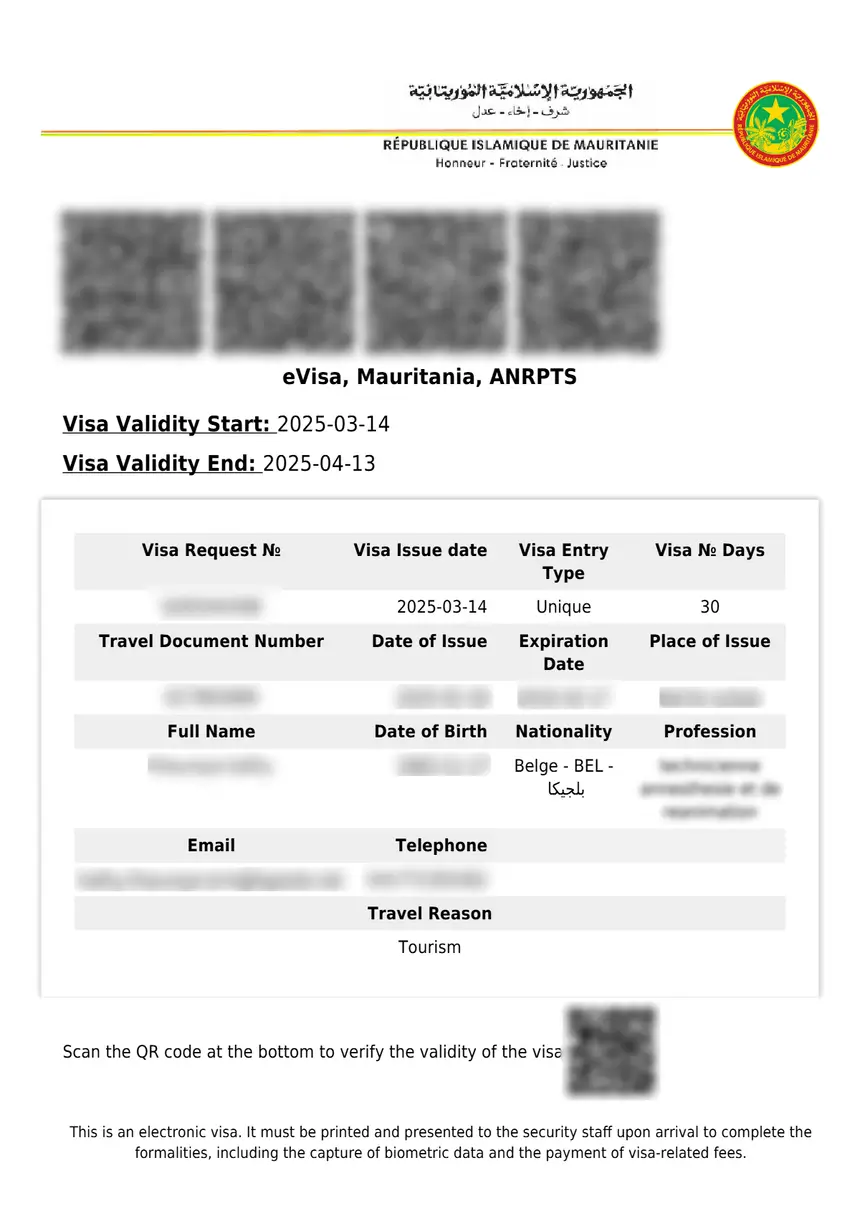
- Receive your approved e-Visa by email as a PDF
For a detailed walkthrough, see our How to Apply for a Mauritania Visa guide.
Step 4: Travel to Mauritania
Print your e-Visa and carry it with your passport. Upon arrival at Nouakchott-Oumtounsy International Airport (NKC), you will:
– Present your e-Visa and passport at immigration
– Have your fingerprints and photo taken (biometric capture)
– Pay the visa fee in exact cash (EUR or USD) at the immigration counter
Step 5: Obtain Your Work Permit and Residence Permit
After arrival, your employer finalizes the work permit process with the Ministry of Employment. Once the work permit is issued, you can begin working legally. If your employment extends beyond your initial visa validity, you will also need to apply for a residence permit (titre de sejour) at the local authorities.
Required Documents for a Mauritania Work Visa
The documents needed fall into two categories: those you need for the e-Visa application, and those your employer needs for the work permit.
Documents You Need (e-Visa Application)
- Valid passport with at least 6 months of remaining validity from your date of entry
- Digital passport scan (information page)
- Passport-style photo (recent, white background, taken within the last 6 months)
- Employment contract or job offer letter
- Flight itinerary or booking confirmation
- Yellow fever vaccination certificate (if arriving from a risk country)
Documents Your Employer Needs (Work Permit Application)
- Completed work permit application form
- Copy of your employment contract
- Your professional qualifications and CV
- Evidence of local recruitment efforts (labor market test)
- Company registration certificate
- Tax clearance certificate
- Justification letter explaining why a foreign worker is needed
- Your passport copy
Additional Documents for Residence Permit
- Valid passport with e-Visa
- Work permit approval letter
- Proof of accommodation in Mauritania
- Passport-size photographs
- Medical certificate (may be required)
- Proof of payment of residence permit fees
Work Visa Fees
The e-Visa fee for work-related entry follows the same structure as all other Mauritania e-Visa categories. The fee depends on your nationality (grouped by region) and the duration you select. Fees are paid in cash upon arrival at Nouakchott airport – not online.
Arab World and Africa
| Duration | Fee (EUR) | Fee (USD) |
|---|---|---|
| 30 days | EUR40 | USD45 |
| 90 days | EUR70 | USD75 |
| 3 months to 1 year | EUR135 | USD145 |
| 1 to 2 years | EUR190 | USD200 |
| 2 to 3 years | EUR270 | USD285 |
| 3 years and above | EUR540 | USD656 |
Rest of World
| Duration | Fee (EUR) | Fee (USD) |
|---|---|---|
| 30 days | EUR55 | USD60 |
| 90 days | EUR95 | USD100 |
| 3 months to 1 year | EUR190 | USD200 |
| 1 to 2 years | EUR270 | USD285 |
| 2 to 3 years | EUR405 | USD425 |
| 3 years and above | EUR810 | USD845 |
Important payment rules:
– Payment is in cash only – euros or US dollars
– Bring the exact amount – no change is given
– No receipts are issued at the immigration counter
– Credit cards, debit cards, and mobile payments are not accepted
– Fees are set by the Mauritanian government and may change
For work employment, the most common durations are 90 days (for initial entry) or 3 months to 1 year (for longer contracts). Choose a duration that covers your expected employment period. For a complete fee breakdown by nationality, see our Mauritania visa fees guide.
Processing Time
The processing time has two components: the e-Visa and the work permit.
E-Visa processing: 3 to 7 business days from the date of submission. During peak travel seasons, it can take 10 to 14 business days.
Work permit processing: 2 to 4 weeks, depending on the Ministry of Employment workload and the completeness of the employer’s application.
The recommended approach is to start both processes in parallel. Apply for the e-Visa as soon as you have your employment contract, and have your employer begin the work permit application at the same time. This way, both approvals can be in hand before your planned travel date.
Tips to avoid delays:
– Apply for the e-Visa at least 3 weeks before your planned departure
– Ensure your passport scan and photo are clear and meet specifications
– Have your employer prepare all work permit documents in advance
– Check your email regularly – ANRPTS may request additional documents
For more details on processing timelines, see our guide on Mauritania visa processing time.
Employer Sponsorship Requirements
The employer plays a central role in the work permit process. Mauritanian labor law requires employers to meet several conditions before hiring a foreign worker:
Labor market test: The employer must demonstrate that they made reasonable efforts to recruit a qualified Mauritanian candidate for the position. This typically involves advertising the position locally and documenting that no suitable local applicants were found.
Employment contract: A formal employment contract must be provided, specifying the role, salary, duration, and working conditions. The contract must comply with Mauritanian labor law.
Company registration: The employer must be a legally registered entity in Mauritania with valid tax clearance.
Minimum salary requirements: Some sectors may have minimum salary thresholds for foreign workers, though these vary by industry and are not uniformly enforced.
Reporting obligations: Employers are required to notify the Ministry of Employment of any changes to the foreign worker’s employment status, including termination, role changes, or contract extensions.
The employer bears most of the administrative burden for the work permit. As an employee, your main responsibility is providing the required personal documents (passport, qualifications, CV) to your employer in a timely manner.
Residence Permit (Titre de Sejour)
If your employment in Mauritania extends beyond your initial e-Visa validity, you need a residence permit (titre de sejour). This is a separate document from both the e-Visa and the work permit.
When to apply: Before your current visa expires. Start the process at least 2 to 3 weeks before the expiry date.
Where to apply: At the local immigration office or prefecture in your area of residence. In Nouakchott, this is handled by the ANRPTS or local authorities.
Documents required:
– Valid passport with current e-Visa
– Work permit approval letter
– Proof of accommodation (rental contract or employer-provided housing letter)
– Passport-size photographs
– Application form (obtained at the immigration office)
– Payment of residence permit fees
Validity: Residence permits are typically issued for 1 year and can be renewed annually as long as employment continues.
Important: Overstaying your visa without a valid residence permit can result in fines, deportation, and future entry bans. Always ensure your documentation is current.
Can You Work in Mauritania with a Tourist or Business Visa?
No. A tourist visa or business visa does not authorize employment in Mauritania. Here is what each visa type allows:
| Visa Type | Allowed Activities | Employment Permitted? |
|---|---|---|
| Tourist | Sightseeing, leisure travel | No |
| Business | Meetings, conferences, trade negotiations | No (but short-term consulting may be tolerated) |
| Work (Other + work permit) | Full employment with employer sponsorship | Yes |
A business visa allows you to attend meetings, sign contracts, negotiate deals, and participate in conferences. It does not allow you to take up a salaried position, perform ongoing work for a Mauritanian entity, or reside in Mauritania for employment purposes.
If you enter on a tourist or business visa and then decide to take a job, you would need to either:
– Leave Mauritania and re-enter with the correct e-Visa category and work permit, or
– Apply for a change of status within Mauritania (subject to approval by immigration authorities, which is not guaranteed)
The safest approach is to obtain the correct documentation before you travel. For a comparison of the different visa types, see our guide to Mauritania visa types.
FAQs About Mauritania Work Visa
Can I work in Mauritania with just an e-Visa?
No. The e-Visa is an entry document only. To work legally in Mauritania, you also need a work permit issued by the Ministry of Employment. Your employer in Mauritania must sponsor the work permit application.
How do I get a work permit for Mauritania?
Your employer in Mauritania applies for the work permit on your behalf through the Ministry of Employment. You need to provide your employer with your passport copy, qualifications, CV, and employment contract. The employer handles the application and the labor market test.
How much does a Mauritania work visa cost?
The e-Visa fee depends on your nationality and duration. For a 90-day visa, the fee is EUR95 (USD100) for most nationalities and EUR70 (USD75) for citizens of Arab and African countries. Longer durations (1 year or more) cost EUR190-810 depending on the period. The work permit has its own separate fee set by the Ministry of Employment.
How long does the work permit process take?
The e-Visa takes 3 to 7 business days. The work permit takes 2 to 4 weeks. Both can be processed in parallel, so start both applications as soon as you have your employment contract.
Can my employer expedite the work permit?
There is no official fast-track option. Processing depends on the Ministry of Employment workload and the completeness of the application. Submitting complete and accurate documents is the best way to avoid delays.
Do I need a residence permit if I have a work permit?
Yes, if your stay in Mauritania exceeds your e-Visa validity. The work permit allows you to work, but the residence permit (titre de sejour) allows you to stay in the country long-term. You apply for the residence permit after arrival.
Can I switch from a tourist visa to a work visa while in Mauritania?
This is technically possible but not guaranteed. You would need to apply for a change of status through the local immigration authorities. The safer approach is to obtain the correct e-Visa category and work permit before traveling.
What happens if I work without a permit?
Working without a valid work permit is illegal in Mauritania. Penalties can include fines, deportation, and a ban on future entry. Both the employee and the employing company can face legal consequences.
Can freelancers or self-employed individuals get a Mauritania work visa?
Mauritania’s work permit system is designed around employer sponsorship. Self-employed individuals or freelancers would typically need to establish a legal entity in Mauritania (such as a company) and then apply for a work permit through that entity. This process is more complex than standard employer-sponsored applications.
Where can I find the official ANRPTS portal?
The official portal is anrpts.gov.mr, operated by the Agence Nationale du Registre des Populations et des Titres Securises (ANRPTS). For support, contact [email protected].