Mauritania does not issue a separate student visa. If you plan to study at a Mauritanian university or institution, you apply through the standard e-Visa system at anrpts.gov.mr and select a duration that covers your academic program. Since January 5, 2025, visa on arrival has been discontinued and Mauritanian embassies no longer issue visas – all applications go through the online portal managed by ANRPTS. This guide explains the exact visa duration, fees, documents, and application steps you need to study in Mauritania as a foreign national.
Does Mauritania Have a Student Visa
Mauritania does not offer a dedicated student visa category. The e-Visa system provides a single authorization for all purposes, including study. When you fill in the online application at anrpts.gov.mr, you select your purpose of travel from the available options. For academic study, you would typically choose the option that best matches your situation.
The key difference for students is the duration you apply for. Short courses or language programs lasting a few weeks fit within the 30-day or 90-day e-Visa. Degree programs lasting one or more semesters require the 3-month to 1-year or 1-year to 2-year duration tier.
Students from 10 visa-exempt countries – Algeria, Burkina Faso, Chad, Cote d’Ivoire, Gambia, Libya, Mali, Niger, Senegal, and Tunisia – can enter Mauritania without a visa for up to 90 days. If your program is longer than 90 days, you still need to apply for an e-Visa with the appropriate duration.
Which Visa Duration Do Students Need
The e-Visa duration you choose depends on the length of your academic program. Mauritania’s e-Visa system offers six duration tiers, from 30 days to 3 years and above.
| Academic Program Length | e-Visa Duration to Select | Typical Use |
|---|---|---|
| Up to 30 days | 30-day e-Visa | Short workshops, summer schools, conferences |
| Up to 90 days | 90-day e-Visa | One semester, language courses, research fieldwork |
| 3 months to 1 year | 3-month to 1-year e-Visa | Full academic year, diploma programs |
| 1 to 2 years | 1-year to 2-year e-Visa | Bachelor’s or master’s programs (renewable) |
| 2 to 3 years | 2-year to 3-year e-Visa | Multi-year degree programs |
| Over 3 years | 3-year and above e-Visa | Full bachelor’s or doctoral programs |
Most international students in Mauritania apply for the 3-month to 1-year tier and renew if their program extends. The longer tiers (1-2 years, 2-3 years) are available but may require additional justification during the application.
Mauritania Student e-Visa Fees
E-Visa fees are paid on arrival in Mauritania in exact cash – Euros or US dollars only. No cards, no change, no receipts. Fees depend on your geographic region and the duration you select.
Fees for Arab World and Africa
| Duration | EUR | USD |
|---|---|---|
| 30 days | 40 | 45 |
| 90 days | 70 | 75 |
| 3 months to 1 year | 135 | 145 |
| 1 to 2 years | 190 | 200 |
| 2 to 3 years | 270 | 285 |
| 3 years and above | 540 | 656 |
Fees for Rest of the World
| Duration | EUR | USD |
|---|---|---|
| 30 days | 55 | 60 |
| 90 days | 95 | 100 |
| 3 months to 1 year | 190 | 200 |
| 1 to 2 years | 270 | 285 |
| 2 to 3 years | 405 | 425 |
| 3 years and above | 810 | 845 |
A student from Nigeria enrolling in a one-year diploma would pay EUR 135 or USD 145 (Arab World and Africa tier). A student from India or Pakistan in the same program would pay EUR 190 or USD 200 (Rest of World tier).
For more details on the complete fee structure, see our Mauritania visa fees guide.
Documents Required for a Mauritania Student Visa
When applying for an e-Visa as a student, you upload documents through the ANRPTS portal. The standard requirements apply, plus student-specific documents.
Standard e-Visa Documents
- Passport valid for at least 6 months beyond your arrival date
- Clear scan of your passport bio-data page
- Recent passport-sized photograph meeting official specifications
- Travel itinerary or flight booking confirmation
Additional Documents for Students
- University admission letter or enrollment confirmation from a recognized Mauritanian institution
- Proof of accommodation in Mauritania (university housing confirmation, rental agreement, or host invitation letter)
- Proof of financial means – bank statements or a scholarship letter showing you can cover tuition and living expenses
- Academic transcripts or previous qualifications (may be requested by the university)
- Health insurance valid in Mauritania for the duration of your stay
The admission letter from your Mauritanian university is the most important student-specific document. It should state your name, program of study, expected duration, and enrollment date.
How to Apply for a Mauritania Student e-Visa
The application process has four stages, all done online through the ANRPTS portal.
Step 1: Secure University Admission First
Before applying for the e-Visa, you need a confirmed place at a Mauritanian university or educational institution. Contact the institution directly to learn about their admission requirements, language prerequisites, and enrollment deadlines. Most Mauritanian universities teach in Arabic and French, so language proficiency in at least one of these is typically required.
Step 2: Apply on the ANRPTS Portal
Go to anrpts.gov.mr/en/visa/requestvisa and complete the online form. Enter your personal details, passport information, travel dates, and select the appropriate duration for your study program. Upload all required documents, including your university admission letter.
Step 3: Wait for Processing
After submission, ANRPTS reviews your application. Standard processing takes 3 to 7 business days, though it can take up to 10 to 14 business days during peak periods. Apply at least 3 to 4 weeks before your program start date to allow time for processing and any corrections.
Step 4: Print and Travel
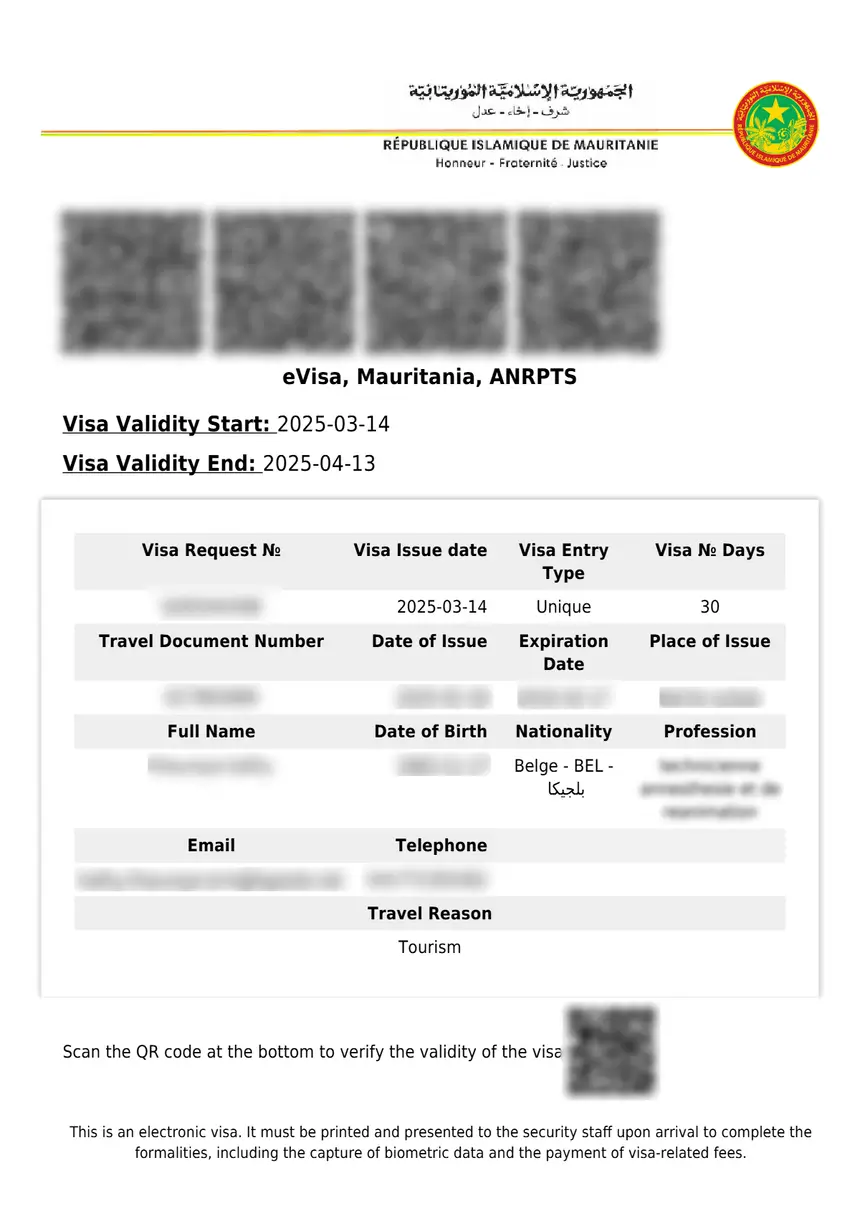
Once approved, print your e-Visa confirmation. Present the printed document at your departure airport and again when you arrive at Nouakchott-Oumtounsy International Airport (NKC). At the immigration checkpoint, your biometric data – fingerprints and a photograph – will be captured. This is a quick process that takes a few minutes.
For the complete step-by-step application process, see our how to apply for a Mauritania visa guide.
Universities in Mauritania for International Students
Mauritania’s higher education system is relatively small but offers programs in key fields. The main institutions include:
| University | Location | Notable Programs |
|---|---|---|
| University of Nouakchott | Nouakchott | Law, Economics, Science, Letters, Arabic and Islamic Studies |
| University of Nouadhibou | Nouadhibou | Fisheries Science, Environmental Studies, Languages |
| Institut Superieur d’Etudes et de Recherche Islamiques | Nouakchott | Islamic Studies, Arabic Language, Theology |
| Ecole Nationale d’Administration (ENA) | Nouakchott | Public Administration, Governance |
| Ecole Normale Superieure (ENS) | Nouakchott | Teacher Training, Education Sciences |
The University of Nouakchott is the largest and most established, founded in 1981. It serves as the primary destination for international students. Programs are taught in Arabic and French, so proficiency in at least one of these languages is essential.
Living Costs for Students in Mauritania
Mauritania is an affordable destination for international students compared to many other countries. The currency is the Mauritanian Ouguiya (MRU).
| Expense Category | Estimated Monthly Cost |
|---|---|
| University accommodation | MRU 3,000-6,000 (USD 75-150) |
| Private room rental | MRU 5,000-12,000 (USD 125-300) |
| Food and groceries | MRU 4,000-8,000 (USD 100-200) |
| Local transport | MRU 1,000-2,000 (USD 25-50) |
| Mobile phone and internet | MRU 500-1,500 (USD 12-37) |
| Health insurance | MRU 2,000-4,000 (USD 50-100) |
Monthly living expenses typically range from USD 200 to 500 depending on lifestyle and accommodation choices. Nouakchott, the capital, is the most expensive city, while costs in Nouadhibou and other towns are lower.
Health Requirements for Students in Mauritania
All travelers entering Mauritania must have a yellow fever vaccination certificate if arriving from a country with yellow fever transmission risk. This applies to students as well.
Additional recommended vaccinations for long-term stays include:
- Hepatitis A and B
- Typhoid
- Meningitis (especially during the dry season)
- Rabies (if you will be in rural areas)
- Routine vaccinations (MMR, tetanus, polio)
Health insurance is strongly recommended and may be required by your university. Mauritania’s healthcare infrastructure is limited, particularly outside Nouakchott. Students should ensure their insurance covers medical evacuation to a nearby country (Senegal or Morocco) in case of serious illness.
For a full overview of entry requirements, see our Mauritania entry requirements guide.
Extending Your Student Visa in Mauritania
If your academic program extends beyond the e-Visa duration you originally selected, you need to apply for a new e-Visa with a longer duration. The e-Visa system does not support in-country extensions.
To extend your stay:
- Apply for a new e-Visa through the ANRPTS portal before your current e-Visa expires
- Select a longer duration tier that covers the remaining period of your studies
- Provide updated documentation, including a letter from your university confirming continued enrollment
- Pay the fee difference on arrival (if traveling out and re-entering) or at the designated payment point
Overstaying your e-Visa validity is taken seriously. Penalties include fines, detention, and potential deportation, which can affect future visa applications to Mauritania and other countries.
Tips for Students Moving to Mauritania
- Learn French or Arabic before arrival. University instruction and daily life operate in these two languages. Basic conversational ability makes a significant difference in your experience.
- Arrange accommodation before arrival. University housing is limited. Contact your institution early to secure a room or ask for recommendations for affordable private rentals near campus.
- Bring exact cash for the visa fee. At the airport, you pay your e-Visa fee in EUR or USD with exact change. No cards, no mobile payments, no change given.
- Register with your embassy. Inform your country’s embassy or consulate in Mauritania (or the nearest one, often in Dakar, Senegal) that you are studying in the country.
- Print multiple copies of your e-Visa. Carry at least two printed copies – one for immigration and one as a backup.
- Get vaccinations early. Yellow fever and other recommended vaccines should be completed at least 10 days before departure for the certificate to be valid.
FAQs About Mauritania Student Visa
Does Mauritania have a student visa?
No. Mauritania does not issue a specific student visa. International students apply through the standard e-Visa system at anrpts.gov.mr and select the duration that matches their academic program.
Can I study in Mauritania with a tourist e-Visa?
Yes. The e-Visa covers all purposes of travel, including study. You select the appropriate duration for your program length. For programs longer than 90 days, apply for the 3-month to 1-year tier or longer.
How much does a student e-Visa for Mauritania cost?
Fees depend on your nationality and duration. For a 3-month to 1-year e-Visa, students from Africa and the Arab World pay EUR 135 / USD 145. Students from the rest of the world pay EUR 190 / USD 200. Fees are paid in exact cash on arrival.
What language are Mauritanian university programs taught in?
Most programs are taught in Arabic and French. Proficiency in at least one of these languages is typically required for admission.
Do I need a university admission letter before applying for the e-Visa?
While the e-Visa application itself does not strictly require an admission letter, you should secure university enrollment first. The admission letter strengthens your application and is essential for the university’s own enrollment process.
How long does the Mauritania e-Visa take to process?
Standard processing takes 3 to 7 business days. During peak travel periods, it can take 10 to 14 business days. Apply at least 3 to 4 weeks before your program starts.
Can I extend my student e-Visa while in Mauritania?
The e-Visa system does not support in-country extensions. If your program extends beyond your visa duration, you need to apply for a new e-Visa through the ANRPTS portal before the current one expires.
Is Mauritania safe for international students?
Mauritania is generally safe for students in Nouakchott and other major cities. Standard precautions apply: avoid traveling to remote areas without local guidance, register with your embassy, and stay informed about local conditions.
What is the main university in Mauritania for international students?
The University of Nouakchott, founded in 1981, is the largest and most established institution. It offers programs in law, economics, sciences, letters, and Arabic and Islamic studies.
Do visa-exempt nationalities still need a visa for long-term study?
Yes. Citizens of the 10 visa-exempt countries can enter Mauritania without a visa for up to 90 days. For study programs longer than 90 days, they need to apply for an e-Visa with the appropriate duration.