Mauritania requires all foreign nationals to meet specific entry requirements at the border, including a valid passport, a pre-approved e-Visa, and – for travellers arriving from yellow fever risk countries – a vaccination certificate. Since January 2025, visa-on-arrival no longer exists; every visa-required traveller must hold an e-Visa obtained through the ANRPTS portal before boarding. For a complete overview of the e-Visa system, see our Mauritania eVisa complete guide. This guide covers every document, checkpoint step, customs rule, and health requirement you will face when arriving in Mauritania.
Passport Validity Requirements for Mauritania
Your passport must be valid for at least 6 months beyond your date of arrival in Mauritania. Immigration officers check this at the first checkpoint and will deny entry to anyone whose passport expires within 6 months. This rule applies to all nationalities, including visa-exempt travellers from the 10 exempt countries.
Mauritania enforces the 6-month validity rule strictly. If your passport expires in 5 months and 29 days, you will be turned away. Renew your passport before travelling if it is anywhere close to the 6-month threshold.
Requirements at the immigration counter:
- Passport: Original physical passport – photocopies, digital scans, or photos on your phone are not accepted
- Validity: Minimum 6 months remaining from the date of arrival
- Blank pages: At least 2 blank pages recommended for entry and exit stamps
- Condition: Passport must be undamaged – torn covers, water damage, or missing pages can result in denial of entry
- Lost or stolen passports: If your passport has been reported lost or stolen to any government, Mauritania will deny entry even if you hold a replacement document
Dual nationals should carry both passports if applicable. Mauritania recognises dual nationality, but you must enter and exit on the same passport. If you hold Mauritanian citizenship, you must use your Mauritanian passport to enter.
e-Visa Printout and Digital Approval
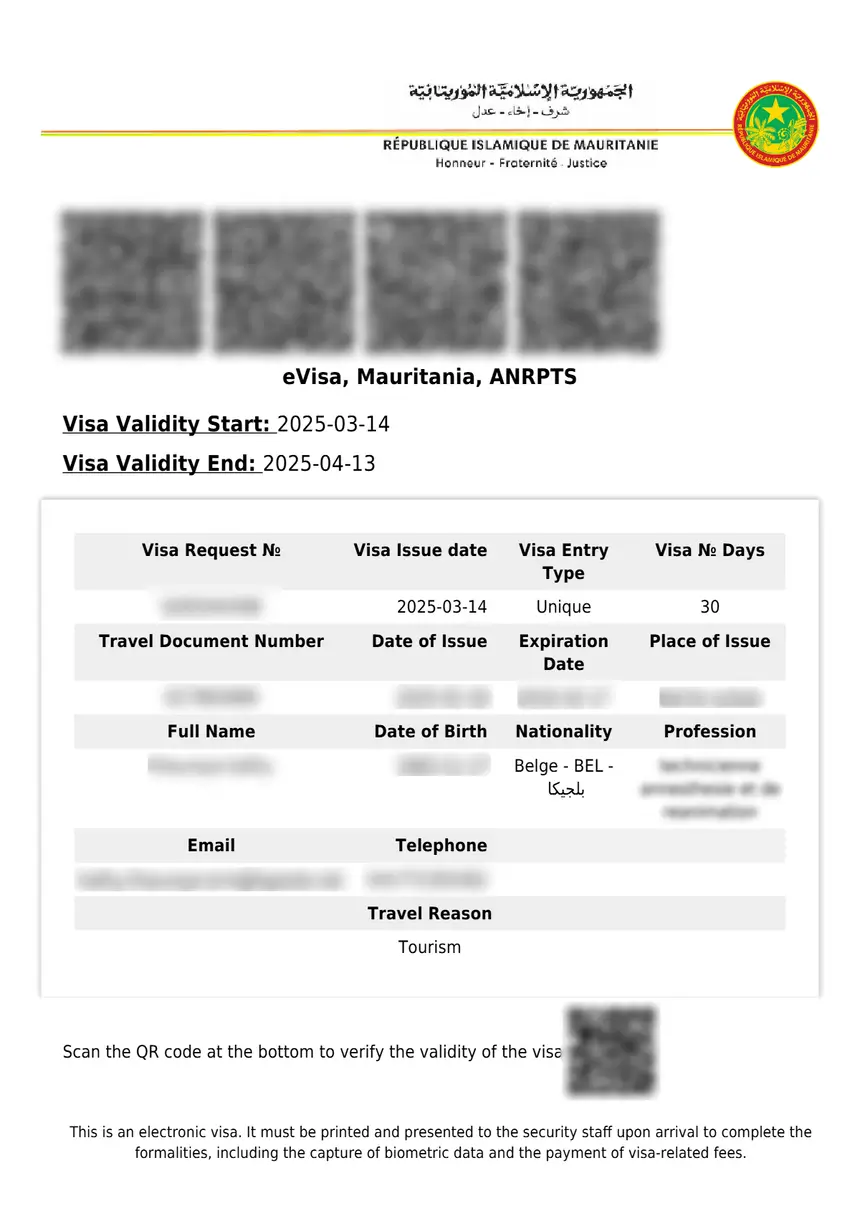
Every visa-required traveller must present a printed copy of their approved e-Visa at the immigration checkpoint. The e-Visa is not a physical sticker in your passport – it is a PDF document sent to your email after approval by ANRPTS (Agence Nationale du Registre des Populations et des Titres Sécurisés).
Since 5 January 2025, visa-on-arrival is no longer available at any Mauritanian airport, land border crossing, or seaport. As of June 2025, Mauritanian embassies worldwide have also stopped issuing visas and direct applicants to the online portal.
What to bring:
- Printed e-Visa: A hard copy of the PDF approval email – digital copies on your phone may be accepted but are not reliable
- Application reference number: Keep your ANRPTS application number accessible in case the officer needs to verify
- Passport used for application: The passport number on your e-Visa must match your physical passport exactly
For step-by-step portal instructions, visit our ANRPTS Mauritania e-Visa portal guide. To check how long processing takes, see Mauritania visa processing time. For the full list of visa categories, visit Mauritania visa types.
Visa duration options available through ANRPTS:
| Duration | Typical Purpose | Entry Type |
|---|---|---|
| 30 days | Tourism, short business | Single or double entry |
| 90 days | Extended tourism, multiple trips | Multiple entry |
| 3 months to 1 year | Work assignments, long-term projects | Multiple entry |
| 1 to 2 years | Extended work, family reunification | Multiple entry |
| 2 to 3 years | Long-term residence, ongoing projects | Multiple entry |
| 3+ years | Permanent work, diplomatic assignments | Multiple entry |
If your e-Visa application was rejected, see our Mauritania visa rejected guide for next steps. For application instructions, visit our how to apply for a Mauritania visa page.
Visa Fee Payment at Arrival
Mauritania e-Visa fees are paid in cash upon arrival – not online during the application process. This is unusual compared to most e-Visa systems and catches many travellers off guard. You must pay in exact Euros or US dollars; immigration officers do not give change and do not provide receipts.
The fee depends on your nationality (geographic zone) and the visa duration you selected during your application.
Fee schedule – Arab World and Africa:
| Duration | EUR | USD |
|---|---|---|
| 30 days | €40 | $45 |
| 90 days | €70 | $75 |
| 3 months to 1 year | €135 | $145 |
| 1 to 2 years | €190 | $200 |
| 2 to 3 years | €270 | $285 |
| 3+ years | €540 | $656 |
Fee schedule – Rest of the World:
| Duration | EUR | USD |
|---|---|---|
| 30 days | €55 | $60 |
| 90 days | €95 | $100 |
| 3 months to 1 year | €190 | $200 |
| 1 to 2 years | €270 | $285 |
| 2 to 3 years | €405 | $425 |
| 3+ years | €810 | $845 |
Critical tips for fee payment:
- Bring the exact amount – officers have no change
- Both EUR and USD are accepted; local currency (Mauritanian Ouguiya, MRU) is not accepted for visa fees
- No receipts are issued – keep a photo of your payment as personal record
- No credit/debit cards accepted at the border
- The fee corresponds to the duration you selected on your ANRPTS application – you cannot upgrade or downgrade at the border
For the complete fee breakdown, see our Mauritania visa fees guide.
Immigration Checkpoint Process
Mauritania captures biometric data – fingerprints and a photograph – from every arriving foreign national at the immigration checkpoint. The process is quick (2-5 minutes) and takes place after your passport and e-Visa have been verified.
When you arrive at Nouakchott-Oumtounsy International Airport (NKC) or any other port of entry, follow this sequence:
Step 1: Queue at the immigration counter
Present your passport (open to the photo page) and your printed e-Visa to the immigration officer. The officer verifies your identity, checks the e-Visa against their system, and confirms your passport validity.
Step 2: Fee payment
If your e-Visa fee has not yet been paid (it is paid on arrival, not online), you will be directed to a payment counter. Pay the exact amount in EUR or USD cash.
Step 3: Biometric capture
Place your fingers on the scanner and look at the camera. The officer captures your fingerprints (usually all 10 fingers) and a frontal photograph. This data is stored in Mauritania’s border security system.
Step 4: Entry stamp
The officer stamps your passport with the entry date and authorised stay duration. Check the stamp before leaving the counter – if the date or duration is incorrect, ask for a correction immediately.
Step 5: Proceed to baggage claim and customs
After immigration, collect your luggage and proceed through customs (see the customs section below).
Yellow Fever and Health Requirements
Mauritania requires a yellow fever vaccination certificate from travellers arriving from countries with risk of yellow fever transmission. This is enforced at the immigration checkpoint – you will be asked to present your International Certificate of Vaccination (the yellow WHO card) before clearing immigration.
Who needs the certificate:
- Travellers arriving from a country listed as a yellow fever risk area (not just transiting through the airport)
- This includes most of Sub-Saharan Africa, parts of South America, and several Caribbean nations
- Travellers who transit through a risk country for more than 12 hours may also be asked
Recommended vaccinations (not required for entry but strongly advised):
- Yellow fever: Strongly recommended for all travellers to Mauritania, even if not technically required from your origin country – yellow fever is widespread in Mauritania itself
- Malaria prophylaxis: Malaria is a year-round risk in most of Mauritania (except the northern Dakhlet-Nouadhibou and Tiris-Zemmour regions)
- Hepatitis A and B
- Typhoid
- Meningitis
- Rabies: Recommended for travellers visiting rural areas
Consult your doctor or a travel health clinic at least 4-6 weeks before departure. TravelHealthPro provides a detailed Mauritania health guide.
Customs Rules and Prohibited Items
Mauritania has strict customs laws and you must declare anything that may be prohibited or subject to duty. Customs officers inspect luggage after immigration, and penalties for violations can include heavy fines, confiscation, or detention.
Prohibited imports – you CANNOT bring these into Mauritania:
- Alcohol – all forms of alcohol are prohibited for import by private citizens
- Firearms and ammunition – unless you hold a specific import permit
- Pork products – import prohibited under Islamic law
- Non-Islamic religious materials – importing materials intended for proselytising is illegal
- Pornographic material
- Narcotics and controlled substances – penalties for drug offences include heavy fines and imprisonment
Items subject to declaration or restriction:
- Cash: You must declare cash amounts exceeding a certain threshold (reportedly 10,000 USD or equivalent) – failure to declare can result in confiscation
- Electronics: Large quantities of electronics may be subject to import duty
- Medications: Carry a prescription and doctor’s letter for any prescription drugs – some medications legal in your home country may be restricted in Mauritania
- Photography equipment: Do not photograph military installations, airports, government buildings, or religious sites without permission
Local laws to know before clearing customs:
- Same-sex relationships are illegal and can carry severe penalties
- Extramarital sex is illegal
- Preaching non-Islamic religions is illegal
- Taking unauthorised photos of military, government, or religious buildings is illegal
- Ramadan is observed – eating, drinking, and smoking in public during daylight hours of Ramadan is considered disrespectful and may attract legal consequences
Land Border Crossings
Mauritania shares land borders with Algeria, Mali, Western Sahara (administered by Morocco), Senegal, and Burkina Faso. The same e-Visa and entry requirements apply at land border crossings as at the airport – there is no separate visa-on-arrival system.
Key land border crossings:
- Rosso (Senegal border): The busiest crossing, located on the Senegal River. Ferry crossing required. Long queues are common, especially on market days. The same e-Visa, passport validity, and fee payment rules apply.
- Nouadhibou (Western Sahara/Morocco border): Used by travellers coming from Morocco or Western Sahara. Less congested than Rosso.
- Bassiknou (Mali border): Remote crossing in the southeast. Security conditions in the Mali border region are unstable – check travel advisories before using this route.
- Fassala (Mali border): Another Mali crossing in the south. Same security concerns apply.
Important for land crossings:
- Biometric capture is performed at all border posts, not just airports
- Fee payment in exact EUR or USD cash applies at all crossings
- Some remote border posts may have limited facilities – bring water, snacks, and photocopies of your documents
- Security conditions near the Mali and Algeria borders are unstable due to Sahel region terrorism and kidnapping risks. The UK FCDO and Australian Smartraveller both advise against travel to border regions with Mali and Algeria
Denial of Entry: Common Reasons
Mauritania can deny entry to any foreign national who does not meet the requirements at the border. Common reasons for denial include:
Document-related denials:
- Passport validity less than 6 months from arrival date
- No printed e-Visa or invalid e-Visa (wrong passport number, expired, or not yet approved)
- Passport reported as lost or stolen
- Damaged passport (torn, water-damaged, missing pages)
- Passport number does not match the e-Visa
Fee-related denials:
- Insufficient cash to pay the visa fee (no cards accepted, no ATM at immigration)
- Wrong currency (only EUR and USD accepted – not MRU, not GBP, not AUD)
Security and legal denials:
- Previous overstay or deportation from Mauritania
- Criminal record flagged at the border
- Name matching a security watchlist
- Carrying prohibited items (alcohol, narcotics, firearms without permit)
Health-related denials:
- Missing yellow fever certificate when arriving from a risk country
If you are denied entry, you will be placed on the next available return flight at your own expense. There is no appeals process at the airport. Contact your embassy or consulate for assistance.
FAQs About Mauritania Entry Requirements
Do I need a visa to enter Mauritania?
Yes, unless you are a citizen of one of 10 visa-exempt countries (Algeria, Burkina Faso, Chad, Côte d’Ivoire, Gambia, Libya, Mali, Niger, Senegal, Tunisia). All other nationalities – including US, UK, Canadian, Australian, Indian, and EU citizens – must apply for an e-Visa online through the ANRPTS portal before travelling. Visa-on-arrival was eliminated on 5 January 2025.
How long does my passport need to be valid for Mauritania?
Your passport must be valid for at least 6 months beyond your date of arrival. Mauritania enforces this rule strictly – if your passport expires within 6 months, you will be denied entry regardless of your visa status.
Can I get a visa on arrival in Mauritania?
No. Visa-on-arrival was discontinued on 5 January 2025. All visa-required nationals must obtain an e-Visa through the ANRPTS portal (anrpts.gov.mr) before boarding their flight or arriving at a land border. As of June 2025, Mauritanian embassies also no longer issue visas.
Do I need to print my e-Visa for Mauritania?
Yes. You must carry a printed copy of your approved e-Visa (the PDF sent to your email by ANRPTS). Immigration officers at the border verify the printed document against their system. Digital copies on your phone may work but are not reliable – always bring a hard copy.
How do I pay the visa fee when I arrive in Mauritania?
The e-Visa fee is paid in exact cash at the border – either Euros (EUR) or US dollars (USD). Officers do not give change and do not accept credit cards, debit cards, or local currency (Mauritanian Ouguiya). Bring the exact amount for your visa duration.
Do I need a yellow fever certificate for Mauritania?
Yes, if you are arriving from a country with risk of yellow fever transmission. You must present your International Certificate of Vaccination (yellow WHO card) at the immigration checkpoint. Even if not technically required from your origin country, yellow fever vaccination is strongly recommended for all travellers because the disease is widespread in Mauritania itself.
What happens if I arrive without an e-Visa?
You will be denied entry. Since January 2025, there is no visa-on-arrival option and no way to obtain a visa at the airport or border. You will be placed on the next available return flight at your own expense. Always obtain your e-Visa before travelling.
Can I enter Mauritania by land from Senegal or Morocco?
Yes. The same e-Visa and passport requirements apply at all land border crossings. The busiest crossing is Rosso on the Senegal River. Biometric capture and fee payment in exact EUR/USD cash apply at all border posts. Security conditions near the Mali and Algeria borders are unstable – check current travel advisories before using those routes.
What items are prohibited at Mauritania customs?
Alcohol, firearms (without permit), pork products, narcotics, non-Islamic religious materials for proselytising, and pornographic material are all prohibited imports. Cash exceeding approximately 10,000 USD must be declared. Penalties for violations include fines, confiscation, and detention.
How long does immigration take when arriving in Mauritania?
The immigration process typically takes 15-30 minutes for most arrivals. This includes passport verification, e-Visa check, fee payment (if applicable), and biometric capture (fingerprints and photograph). At Nouakchott-Oumtounsy International Airport (NKC), the process is straightforward. Land border crossings may take longer depending on queue size and officer availability.
What currency should I bring for visa fees at the border?
Bring Euros (EUR) or US dollars (USD) in the exact amount for your visa duration. For most travellers from outside Africa and the Arab world, a 30-day visa costs €55 or $60, and a 90-day visa costs €95 or $100. There is no ATM at the immigration counter and no change is given.
Is Mauritania safe for tourists?
The Sahel region has elevated terrorism and kidnapping risks, particularly near the Mali, Algeria, and Western Sahara borders. Most tourist areas, including Nouakchott, are considered relatively safe for travellers who take standard precautions. Check your government’s travel advisory (UK FCDO, US State Department, Australian Smartraveller) for the latest assessment before travelling.